

The word "optional" is easily the most misleading term in modern formal etiquette. You open an invitation, see those three words, and immediately start wondering if you'll be the only bloke in a tuxedo or the only one underdressed in a standard business suit. It's a common source of anxiety for New Zealand gents who want to show respect for the occasion without feeling out of place. Most men feel that same flicker of dread when a dress code isn't crystal clear, fearing a costly mistake or an awkward wardrobe mismatch.
We're here to help you master the black tie optional dress code with absolute confidence and zero stress. This guide decodes the rules of the game, ensuring you look spot on whether you choose a classic dinner suit or a sharp charcoal alternative. We'll walk you through the essential components of the look, explain how to get the fit right every time, and show you how Frank Casey makes sourcing the perfect gear simple. Whether you're attending a local gala or a high-end wedding, you're about to become the best-dressed guest in the room.
Key Takeaways
- Understand that "optional" is an invitation to dress up, not down, with the tuxedo remaining the preferred choice for the host.
- Master the black tie optional dress code by prioritising a tailored fit and dark, classic colours to ensure you never look out of place.
- Use formal accessories like white linen pocket squares and polished dress shoes to elevate a high-end business suit for the evening.
- Avoid common style mistakes by ditching button-down collars and loud patterns in favour of timeless, sophisticated silhouettes.
- Explore how professional suit hire offers a cost-effective way to access expert fitting services and premium formal wear for any New Zealand event.
What Exactly Does Black Tie Optional Mean?
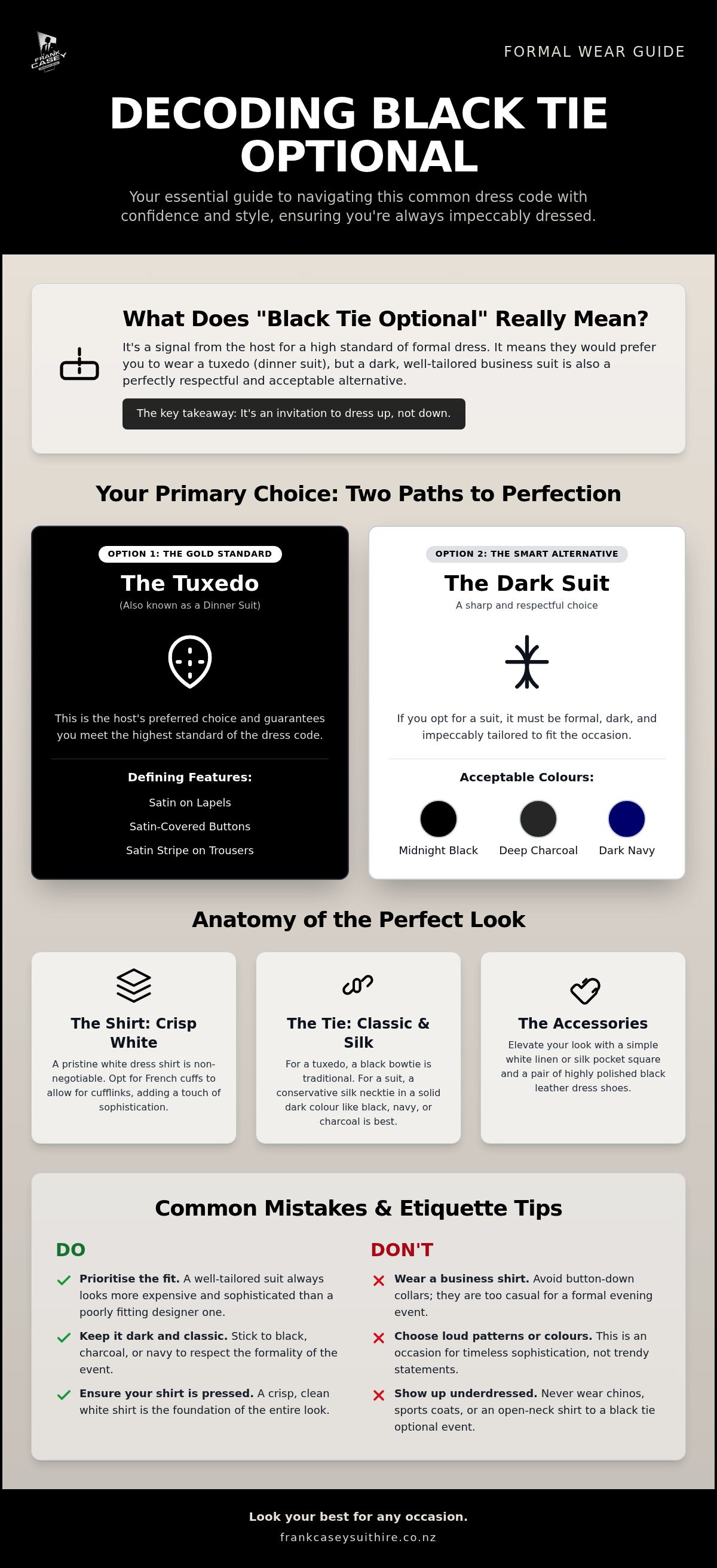
The black tie optional dress code often feels like a riddle wrapped in an invitation. It sits in that delicate middle ground between a full Black tie dress code and a standard formal event. Essentially, it gives you two paths to follow. Black Tie Optional is a dress code indicating that while a tuxedo is requested, a dark, formal suit is a respectful and acceptable alternative.
Don't let the word "optional" lure you into a false sense of casualness. It isn't a license to show up in chinos or an open-neck shirt. In the hierarchy of formal wear, this code remains high. You're still expected to wear a tie and look your absolute best. Think of it as the host saying, "We'd love you to wear a dinner suit, but we won't turn you away if you wear a sharp business suit instead."
The Host’s Intent: Why Use This Code?
Hosts usually choose this code when they want to create a sophisticated, high-end atmosphere without making a tuxedo mandatory for every guest. It's incredibly common for New Zealand weddings and charity galas where the goal is a polished aesthetic. By setting this standard, the host ensures that event photos look uniform and elegant. It prevents a jarring contrast where half the room is in evening wear and the other half looks ready for a Tuesday morning board meeting.
Tuxedo vs. Dark Suit: The Primary Choice
Your main decision involves whether to stick with a tuxedo or opt for a suit. A tuxedo, often called a dinner suit in New Zealand, is the gold standard for any black tie optional dress code. The defining feature of a tuxedo is the presence of satin on the lapels, buttons, and usually a stripe down the trouser leg. These subtle details signal that you've dressed specifically for an evening celebration.
If you decide to wear a suit, it must be formal. This isn't the time for light colours like tan or light grey. Stick to dark, conservative shades that command respect. Consider these options:
- Midnight black: The safest and most formal choice for a suit.
- Deep charcoal: A versatile alternative that still feels appropriately "evening."
- Dark navy: A classic look that works well under artificial light.
A well-tailored dark suit, paired with a crisp white shirt and a conservative silk tie, ensures you meet the requirements with style. Frank Casey has decades of experience helping blokes distinguish between these options to find the right fit for their specific event.
The Anatomy of the Black Tie Optional Look
Success with the black tie optional dress code comes down to the individual components of your outfit. You don't need to spend a fortune to look like a million bucks; the secret is to prioritise the silhouette. A suit that fits correctly across the shoulders and tapers at the waist will always outshine a poorly fitted designer piece. This is why professional suit fitting NZ is such a vital part of the process. It transforms a standard garment into a tailored masterpiece that complements your body type and ensures you move with confidence.
Your shirt should be a pristine, crisp white. Texture can be a nice touch, but keep it subtle so it doesn't distract. French cuffs are the preferred choice because they allow for cufflinks, which add a layer of sophistication to your wrists. The collar should be stiff enough to stand up under a jacket without sagging. A spread collar is particularly effective if you plan on wearing a larger tie knot, as it provides enough space for the silk to sit comfortably. Ensure the shirt is freshly pressed, as even the best suit can't hide a wrinkled collar.
Choosing the Right Suit Colour
When navigating the black tie optional dress code, your colour choice is your first major decision. Black remains the gold standard for those opting out of a dinner suit. It's formal, slimming, and impossible to get wrong. If you want something slightly different, midnight navy is a brilliant alternative. It has a modern edge and looks incredibly sharp under ballroom lighting, often appearing richer than black. Charcoal grey is your final option. It's just dark enough to pass for formal, but avoid anything lighter to stay within the host's expectations. This ensures you remain respectful of the event's gravity while still allowing for a hint of personal style.
The Shirt and Tie Combination
A white dress shirt is non-negotiable for this look. When it comes to the tie, you have a choice between a bowtie and a necktie. If you're wearing a suit rather than a tuxedo, a long necktie is often the more natural fit. Stick to solid colours in high-quality silk. Darker shades like black, navy, or charcoal are best. Avoid loud patterns or bright colours that might distract from the overall formal vibe.
Make sure your tie is tied with a neat knot, like a Four-in-Hand or a Half-Windsor, and ensure the tip just reaches your belt line. When reviewing Common Mistakes and Etiquette Tips, the most frequent error is trying to be too creative. Simplicity is your best friend here. If you're looking to take the guesswork out of your next event, you can view our range of hire suits to find your perfect match.
Elevating Your Suit with Formal Accessories
When you choose a dark suit over a dinner suit, your accessories do the heavy lifting. They provide the visual cues that signal "evening" rather than "office." These small details, often referred to as the jewellery of a man's outfit, transform a standard ensemble into a black tie optional dress code winner. By selecting high-end finishing touches, you show your host that you've understood the gravity of the occasion. It's about precision rather than flashiness.
The difference between a workday look and a formal one is often found in the textures and colours you choose. While your daily routine might involve patterned ties or brown brogues, this specific code demands a more restrained palette. Following Emily Post's black tie optional guide ensures you stay within the bounds of traditional etiquette while still looking modern and sharp.
| Item | Standard Business | Black Tie Optional |
|---|---|---|
| Tie | Striped or patterned silk | Solid black or midnight silk |
| Pocket Square | Coloured or patterned silk | Crisp white linen |
| Cuffs | Button cuffs | French cuffs with cufflinks |
| Footwear | Brown or black brogues | Polished black Oxfords |
Footwear: Putting Your Best Foot Forward
Shoes are the foundation of your formal look. While patent leather is the traditional choice for a tuxedo, it can look slightly "off" when paired with a standard wool suit. Instead, opt for highly polished black leather Oxfords. The key word here is "polished." Your shoes should have a mirror-like shine that reflects the evening lights. If your current wardrobe lacks the right pair, formal shoe hire is a practical way to ensure your footwear matches the quality of your suit without the long-term investment.
The Finishing Touches: Cufflinks and Pocket Squares
A pocket square is a non-negotiable element of the black tie optional dress code. Stick to white linen and use a flat "TV fold" for a clean, horizontal line across your chest. This looks far more intentional and formal than a loose "puff" fold. For your wrists, choose cufflinks that add a subtle touch of personality. Avoid novelty shapes. Stick to classic metals like silver, gold, or onyx to keep the look cohesive. Finally, don't forget your socks. They must be dark, over-the-calf, and made of a fine knit. Nothing ruins a formal silhouette faster than a flash of bare skin when you sit down.
Common Mistakes and Etiquette Tips
The biggest trap with the black tie optional dress code is the word "optional" itself. It's easy to assume this is a suggestion to dress down, but the reality is quite the opposite. This code is a request for formality. If you treat it like a casual Friday at the office, you'll feel out of place the moment you walk through the door. You're being invited to join a high-end atmosphere, and your clothing should reflect that respect.
Timing plays a massive role in how you should interpret the invite. For events starting after 6 PM, the expectation leans much closer to traditional black tie. At this hour, the dinner suit is the undisputed king. If the sun is still up, you might get away with a sharp dark suit, but once the evening lights come on, the tuxedo truly shines. It's about matching the energy of the room as the night progresses.
What to Avoid at All Costs
Certain items simply have no place here. Leave your tan, light grey, or brown suits in the wardrobe. They're too casual and belong at daytime garden parties, not evening galas. Your shirt choice is equally critical. Never wear a button-down collar; it's a sport shirt feature that clashes with the formality of a tie. Similarly, loud patterns or bright colours will only serve as a distraction. Keep your timepiece understated too. A chunky sports watch or a digital fitness tracker ruins a clean cuff line. Stick to a slim dress watch with a leather strap to maintain a sophisticated silhouette.
When the "Optional" Becomes "Required"
Sometimes, the choice is made for you by the context of the event. If the venue is a high-end hotel ballroom or a historic estate, the tuxedo is effectively mandatory. The architecture alone demands a higher standard. Your role at the event also matters. If you're a member of the wedding party or a close relative of the hosts, you should definitely opt for the dinner suit. It shows a level of respect and commitment that a standard suit can't quite match.
It's a golden rule of etiquette: it's always better to be the best-dressed man in the room than the one who didn't try hard enough. If you're unsure which way to go, book a fitting with Frank Casey to ensure your look is perfectly calibrated for the occasion. We've been helping New Zealanders get this right since 1987, taking the guesswork out of every invitation.
Hire vs. Buy: Why Frank Casey Makes It Easy
Deciding whether to purchase or hire for a black tie optional dress code event often comes down to how frequently you attend formal functions. For many New Zealanders, these events are significant milestones rather than weekly occurrences. Investing upwards of $1,000 in a dinner suit that spends most of the year in a garment bag doesn't always make financial sense. Hiring allows you to access high-end tailoring without the hefty price tag or the long-term maintenance requirements.
The Benefits of Hiring for Black Tie Optional
Choosing to hire gives you immediate access to premium fabrics and the latest styles. You aren't locked into a single look for the next decade. If you want a classic black tuxedo for a wedding this month but a sharp midnight navy suit for a charity gala next year, hiring makes that possible. It's a way to keep your formal wardrobe fresh and relevant to the specific occasion.
There is also the matter of convenience. Formal wear requires specialist care. When you hire through Frank Casey, you don't have to worry about dry cleaning or finding space for long-term storage in a crowded wardrobe. You simply enjoy the event, return the gear, and let us handle the rest. This hassle-free approach is a core part of our nationwide suit hire service, designed to take the stress out of your preparation.
The Frank Casey Experience
Since 1987, we've focused on providing more than just a garment. We provide the expertise needed to ensure you look spot on. Our professional fitting service is included with every rental, ensuring your silhouette is sharp and comfortable. We understand that a great suit is nothing without a perfect fit. Our team offers choosing the right suit for the occasion advice, helping you navigate the subtle differences between a tuxedo and a dark business suit.
Our nationwide reach means you can get sorted regardless of where the event is held. Whether you visit one of our stores for a personal fitting or use our streamlined online ordering system, the quality remains consistent. We take pride in being a supportive partner for your most important life events. Ready to nail the dress code? Explore our Black Tie collection today and find the perfect look for your next New Zealand event.
Step Out with Total Confidence
Mastering the black tie optional dress code doesn't have to be a source of stress. By understanding that the host prefers a dinner suit but respects a high-quality dark suit, you can make an informed choice that suits your style and the occasion. Remember that the secret lies in the details; a crisp white shirt, polished Oxfords, and a perfectly tailored silhouette will always ensure you look the part. Whether you choose the timeless elegance of a tuxedo or the versatility of a charcoal suit, your confidence will be your best accessory.
As New Zealand’s leading formal wear specialists since 1987, Frank Casey is here to take the guesswork out of your wardrobe. We provide a professional fitting with every hire to guarantee you look spot on, and our nationwide delivery makes getting sorted easier than ever. You don't need to navigate the rules of formal etiquette alone when expert guidance is just a click away. Browse our Black Tie Hire collection and get sorted for your next event. We look forward to helping you make a lasting impression at your next celebration.
Frequently Asked Questions
Do I have to wear a tuxedo for a black tie optional wedding?
No, you aren't required to wear a tuxedo, though it remains the preferred choice for the black tie optional dress code. The "optional" part means the hosts would love to see you in a dinner suit, but they won't be offended if you choose a sharp dark suit instead. If you're a close family member or part of the wedding party, we usually recommend opting for the tuxedo to match the high level of formality.
Can I wear a black business suit for black tie optional?
Yes, a black business suit is a perfectly acceptable alternative to a dinner suit. To make it work, ensure the suit is dark, conservative, and fits you perfectly. You should pair it with a crisp white dress shirt and a dark silk tie to maintain the formal evening aesthetic. This choice allows you to look sophisticated without needing to invest in a full tuxedo for a single event.
What colour tie should I wear for black tie optional?
Stick to solid, dark colours to ensure your tie matches the gravity of the occasion. Black, midnight navy, or deep charcoal are the best choices for a black tie optional dress code. Avoid loud patterns, bright colours, or knitted textures that feel too casual for the evening. A high-quality silk tie with a neat knot provides the polished finish needed to elevate a standard suit into the formal realm.
Is a bowtie required for black tie optional?
A bowtie isn't required if you're wearing a dark suit, though it's mandatory if you choose a tuxedo. For those in a standard suit, a long silk necktie is the more natural and traditional choice. If you want to lean closer to the black tie end of the spectrum while wearing a suit, a black bowtie can work, provided the rest of your accessories are equally formal and your shirt has a hidden placket.
Can I wear a navy suit to a black tie optional event?
You can wear a navy suit as long as it's a very dark, midnight navy. Lighter shades of blue are too casual for this specific dress code and should be avoided for evening functions. A dark navy suit looks sharp under artificial light and offers a modern alternative to black. Just ensure your accessories, like your shoes and tie, remain strictly formal to keep the look cohesive and respectful of the host.
What is the difference between formal and black tie optional?
The main difference lies in the host's expectation for evening wear. A formal dress code typically allows for a wider range of suit colours and styles, whereas black tie optional specifically signals a preference for tuxedos. By using this code, the host is asking for the highest level of formality while acknowledging that not every guest owns a dinner suit. It's a slightly more restrictive standard than a general formal request.
Do I need to wear patent leather shoes?
Patent leather shoes are only necessary if you're wearing a tuxedo. If you've opted for a dark suit, highly polished black leather Oxfords are the correct choice. The key is the level of shine; your shoes should be cleaned and buffed until they reflect the evening light. Avoid loafers, brogues with heavy detailing, or any footwear in brown, as these will lower the formality of your entire outfit and look out of place.
How far in advance should I organise my suit hire?
We recommend booking your suit hire at least four to six weeks before your event. This timeframe ensures you have the widest selection of styles and sizes available, particularly during the busy New Zealand wedding and ball seasons. While Frank Casey can often accommodate last-minute requests, giving yourself plenty of time allows for a relaxed fitting process and ensures every detail of your outfit is perfect before you head out the door.


