

You can spend thousands on the finest wool, but if the shoulders are off by even a centimetre, you'll still look like you're wearing your older brother's hand-me-downs. It is a common frustration for many Kiwi men; you want to look sharp for a wedding or a big corporate event, yet you end up feeling restricted and messy. This how a suit should fit guide is your definitive resource for 2026, designed to help you master the balance between a crisp silhouette and genuine comfort.
We understand that formal etiquette can feel like a maze of unspoken rules. You likely already know that a boxy jacket or bunching trousers can ruin your confidence before you even step out the door. We're here to simplify the process. This article breaks down the essential standards for every component of your attire, from the way your jacket collar hugs your neck to the precise amount of shirt cuff that should peek out. We will preview the technical checks for shoulders, sleeves, and hems that professional tailors use. By the end, you'll know exactly how to achieve a tailored finish that allows for effortless movement all night long.
Key Takeaways
- Identify why the shoulders are the most critical part of a jacket and why getting this right is essential for a sharp silhouette.
- Use this how a suit should fit guide to master the 'two-finger rule' for collars and ensure your waistcoat correctly meets your trousers.
- Learn how to spot and avoid common fit disasters like the lapel gap or a saggy seat in your trousers.
- Discover why a professionally fitted hire suit can provide the same polished, tailored look as a high-end retail purchase.
- Understand the importance of professional measurements to ensure you stay comfortable and look sharp throughout a long New Zealand event.
The Golden Rule of Formal Wear: Why Fit Trumps Brand
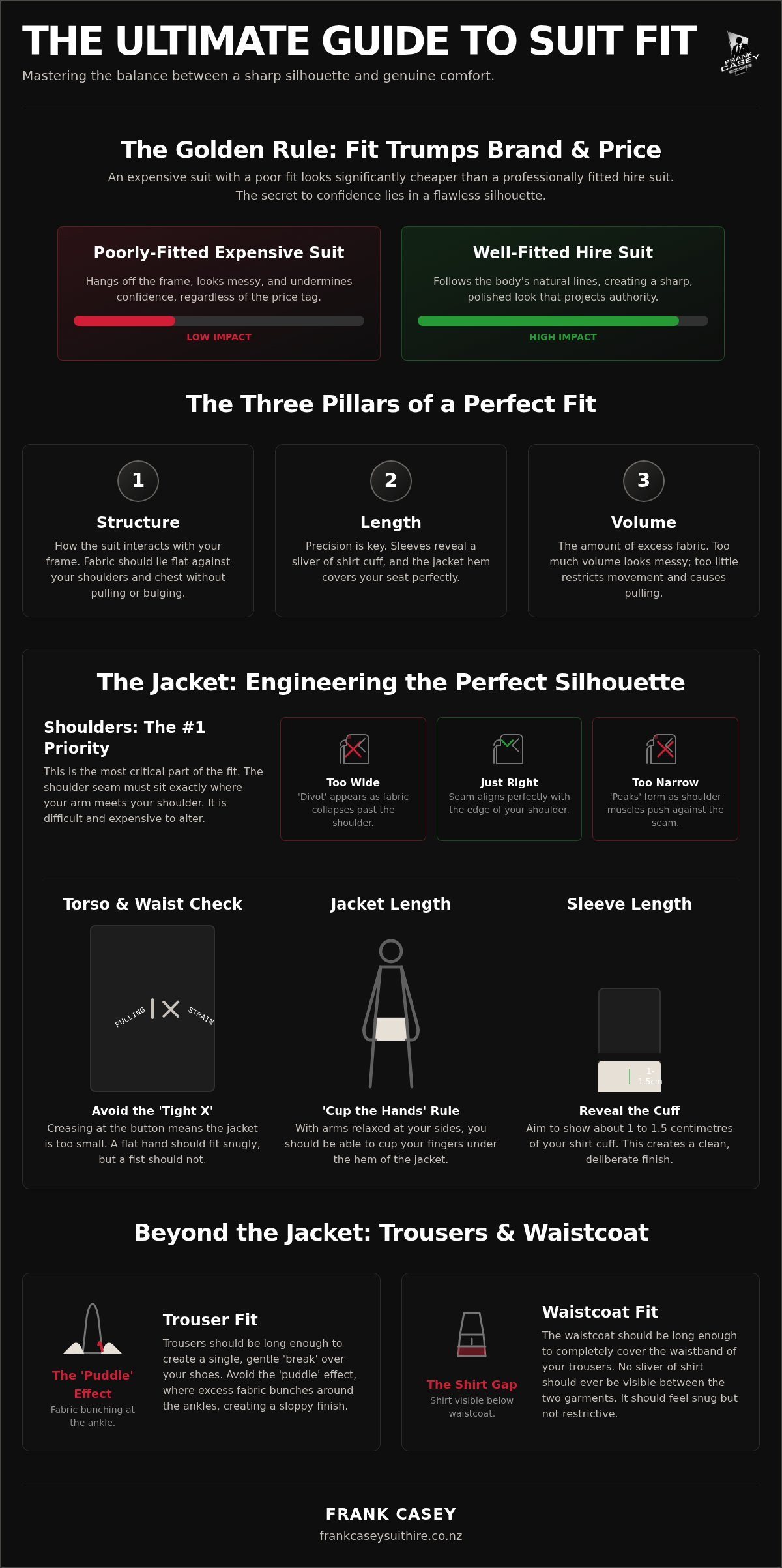
Price doesn't buy style. A common misconception in formal wear is that a high price tag guarantees a sharp look. In reality, the most expensive wool counts for nothing if the jacket hangs off your frame like a tent. Before you dive into specific styles, it's helpful to consult a Definitive Guide to Suits to understand the core components. Ultimately, a perfect fit is defined as a garment that follows the natural lines of your body without pulling or sagging. It should feel like a 'second skin'; structured enough to project authority but comfortable enough to wear through a long wedding reception or a corporate gala.
Many men believe that buying an off-the-rack suit is always superior to hiring. However, an expensive retail suit with a poor fit looks significantly cheaper than a professionally fitted hire suit. When you use this how a suit should fit guide, you'll see that the secret lies in the silhouette. A sharp, tailored line at a wedding or school ball provides a massive psychological boost. You aren't just wearing clothes; you're wearing confidence. You feel capable, relaxed, and ready to engage with the room because you aren't constantly adjusting a collar or tugging at your trousers.
The Three Pillars of Suit Fit
To achieve a professional look, you must consider three fundamental elements that define your silhouette:
- Structure: This is how the suit interacts with your physical frame. It starts at the shoulders and chest, where the fabric should lie flat against your body without any bulging.
- Length: Precision is key here. Your jacket sleeves should reveal a small sliver of shirt cuff, while your jacket hem should cover your seat.
- Volume: This refers to the amount of excess fabric around your waist and limbs. Too much volume creates a messy appearance, while too little restricts your movement and causes the fabric to pull.
Common Fit Mistakes to Avoid
By following this how a suit should fit guide, you can avoid the common pitfalls that lead to a messy appearance. Here is what to watch for during your fitting:
- The 'Boxy' Look: This happens when there is too much fabric in the torso. It hides your natural waistline and makes you look wider and shorter than you actually are.
- The 'Tight' X: If you see creasing at the main jacket button that forms an 'X' shape, the jacket is too small. It's a clear signal of a poor fit that looks strained and uncomfortable.
- The 'Puddle' Effect: This occurs when trousers are too long, causing the fabric to bunch up around the ankles. It creates a sloppy finish that detracts from an otherwise sharp outfit.
The Jacket: Engineering the Perfect Silhouette
The jacket is the centrepiece of your formal attire. It creates the V-shaped frame that projects confidence and authority. While trousers and waistcoats are important, the jacket is where most fit errors occur. Using this how a suit should fit guide will help you identify the structural markers of a high-quality silhouette. Shoulders are the most critical component. Unlike a trouser hem or a waist taper, shoulders are incredibly difficult and expensive to alter. If the shoulders don't fit at your initial fitting, the jacket is the wrong size.
The Shoulder Alignment Check
The shoulder seam should sit exactly where your arm meets your shoulder. If the seam extends past your natural frame, the fabric will collapse, creating an unsightly 'divot'. Conversely, if the seam is too short, you'll see 'peaks' where your shoulder muscles push against the sleeve head. You can test this by performing a simple movement check; hug yourself firmly. The jacket should feel snug across your back but shouldn't feel like the seams are under extreme stress. For more on modern proportions, The GQ Guide to Suits offers excellent insights into how contemporary silhouettes have evolved.
The Torso and Waist Taper
A well-fitted jacket should follow the natural curve of your torso without being restrictive. You can verify this with the 'Button Test'. Slide a flat hand between your chest and the buttoned jacket; it should fit comfortably. If your hand can't fit, the jacket is too tight. If you can easily fit a fist, it's too loose. You should also consider the vent style. A single vent is traditional, but a double vent often provides a more flattering silhouette for men who want better ease of movement when sitting or reaching into pockets.
Finally, pay attention to the lengths. The 'cup the hands' rule is a reliable standard for jacket length. With your arms at your sides, you should be able to cup your fingers under the hem of the jacket. For your sleeves, aim to show about 1 to 1.5 centimetres of shirt cuff. This small detail prevents your arms from looking too long and adds a polished finish to your overall appearance. If you want to ensure every detail is spot on, the expert fitters at Frank Casey specialise in making sure your hire jacket looks like a custom-tailored piece.
The Trousers: Balancing Comfort with a Sharp Line
While the jacket provides the structure, your trousers define the movement and comfort of your ensemble. It's a common mistake to treat suit trousers like a pair of weekend chinos. In this how a suit should fit guide, we emphasise that formal trousers are designed to drape, not cling. The waist should be snug enough to stay up without a belt, even if you choose to wear one for style. Crucially, the rise, which is the distance from the crotch to the waistband, should allow the trousers to sit at your natural waistline rather than your hips. This creates a longer leg line and prevents your shirt from bunching throughout the day.
The seat is often where men struggle most during a fitting. You want to avoid the 'saggy bottom' look that suggests the trousers are too big, but you also don't want them so tight that the pockets flare open. A clean, smooth drape through the glutes is the hallmark of a professional fit. If the fabric pulls horizontally across the front or back, you need a larger size or a different cut. Since 1987, Frank Casey has focused on these nuances to ensure every hire suit provides a sharp, tailored silhouette regardless of body type.
Understanding the 'Break' Options
The 'break' is the fold of fabric created when the trouser hem meets your shoe. This choice significantly impacts your overall aesthetic and should be decided based on the formality of the event:
- No Break: This is a modern, clean look where the hem just brushes the top of the shoe. It's an increasingly popular choice for school balls and contemporary weddings in New Zealand.
- Half Break: The standard for most formal occasions. It features a slight, single fold of fabric at the front, offering a timeless and polished appearance.
- Full Break: A more traditional, conservative style with a deeper fold. While classic, it requires a wider trouser leg to avoid looking messy or accidental.
The Thigh and Calf Width
Your trousers must allow for a full range of motion. You'll likely spend a significant portion of your event sitting down or moving between groups of guests. Use the 'Pinch Test' to check the width; you should be able to comfortably pinch 2 to 3 centimetres of fabric at the mid-thigh. If you can't, the trousers are likely too slim and will pull at the seams when you sit. Perform a quick movement test by squatting slightly. The fabric should feel secure but shouldn't feel like it's under extreme tension. Expert fitters ensure your trousers are adjusted to your specific measurements, providing a retail-quality finish that stays comfortable all night.
Beyond the Wool: Shirt, Shoes, and Accessory Fit
A sharp jacket and well-draped trousers are only half the battle. To truly master this how a suit should fit guide, you must pay equal attention to the items that frame your woollen garments. A poorly fitted shirt or the wrong shoe profile can instantly clutter a clean silhouette. For those planning a wedding, this focus on precision often extends to the entire couple; while the groom refines his suit, many brides look to Hanna Peters for custom couture gowns that offer an equally high standard of fit and design. Every element, from the height of your collar to the width of your tie, needs to work in harmony to ensure you look your best for your next big New Zealand event.
The Dress Shirt Fit
Accessories are where you can inject personality, but they must remain in proportion. Your tie or bowtie width should generally match the width of your jacket's lapels. A skinny tie with wide lapels looks unbalanced and dated. If you're wearing a three-piece suit, the waistcoat is a powerful tool for your silhouette. It should cover your trouser waistband completely; no shirt fabric should be visible between the waistcoat and the trousers. This creates a continuous line of colour that cleans up your midsection for a highly formal appearance.
For a deeper dive into choosing the right items, check out our formal accessories hire NZ guide for more detail on ties and pocket squares.
Don't overlook your footwear. Formal shoes should have a sleek silhouette, especially for black tie events. Ensure there is no heel slippage when you walk, as this causes discomfort over a long day and can lead to blisters. The profile of the shoe must also complement your trouser leg width; slim trousers require a more refined, narrow shoe, while traditional cuts can handle a sturdier sole. If you're unsure about matching your accessories, you can book a professional fitting to ensure every detail of your hire is perfectly coordinated.
Professional Fitting vs. Guesswork: Getting it Right in New Zealand
Attempting to measure yourself at home with a sewing tape often leads to fit disasters. While you might get the numbers right, a tape measure cannot account for your posture, the slope of your shoulders, or how you move. This how a suit should fit guide has covered the technical standards, but the human element is what truly brings a garment to life. Professional fitters possess an 'expert eye' developed through years of experience; they see the nuances that a DIY approach misses, ensuring your suit doesn't just meet the rules but actually flatters your specific body type.
A common question for Kiwi men is whether they should hire or buy. If you only attend one or two formal events a year, a hire suit from Frank Casey is a brilliant solution. We pride ourselves on the fact that our hire suits are professionally fitted to look exactly like a retail purchase. However, if you're the groom or want a garment that is uniquely yours, investing in a custom made wedding suit NZ provides the ultimate fit. Custom-made options allow for structural adjustments that off-the-rack garments simply cannot match, providing a level of comfort and precision that lasts a lifetime.
The Benefit of Professional Fitting Services
Expert fitters identify subtle issues that most people overlook. For example, a 'collar roll' (excess fabric bunching just below the jacket collar) or uneven shoulders can ruin a silhouette. These are common issues that require professional knowledge to correct. When you use a professional suit fitting NZ service, these adjustments are often included in the process. This provides immense peace of mind for high-stakes events like weddings and corporate galas, where you want to focus on the occasion rather than worrying about your trousers being too long or your jacket pulling.
Nationwide Hire Logistics
Since 1987, Frank Casey has refined the art of nationwide service. We understand that not every client is located near a physical store, so we've developed a methodical system to ensure fitting accuracy across New Zealand. Whether you are part of a wedding party spread across the country or a student preparing for a school ball, our logistics ensure your suit arrives on time and fits correctly. We always conduct a 'Final Check' before your event. This is the moment where we verify every hem and sleeve length one last time, ensuring you walk out with a sharp, tailored silhouette. Ready to look your best? Book a fitting with Frank Casey today and experience the difference that professional guidance makes.
Step Out with Confidence at Your Next Event
Achieving a sharp silhouette is about more than just matching colours; it is about structural alignment and ease of movement. We have explored why the shoulders are the non-negotiable anchor of your jacket and why the drape of your trousers matters just as much as the quality of the wool. This how a suit should fit guide provides the essential standards you need to ensure every detail, from shirt cuffs to waistcoat length, works in your favour.
Since 1987, our specialists have helped men across the country achieve a polished, retail-quality look through expert guidance. With professional fitting included in every hire and reliable nationwide delivery across New Zealand, we take the stress out of dressing for significant life events. Hire your perfectly fitted suit from Frank Casey today and let our team handle the technicalities. You deserve to look sharp and feel completely comfortable from the first photograph to the final dance.
Frequently Asked Questions
How long should suit sleeves be?
Suit sleeves should end exactly at the base of your thumb, where your wrist meets your hand. This length ensures that when you stand with your arms at your sides, about 1 to 1.5 centimetres of your shirt cuff remains visible. It prevents the jacket from looking too large and adds a polished finish to your silhouette. Our expert fitters at Frank Casey check this measurement during every fitting to ensure your hire suit looks perfectly tailored.
How should suit trousers fit at the waist?
Suit trousers should sit at your natural waist, which is higher than where you wear casual jeans. They should be snug enough to stay in place without a belt, though you might choose to wear one for style. If the waistband is too tight, it will cause the fabric to bunch or the pockets to flare. Correct alignment here is a key part of any how a suit should fit guide and ensures all-day comfort.
What is a suit 'break' and which one should I choose?
A 'break' is the fold of fabric created where your trouser hem rests on your shoe. For a modern and clean look, many men choose 'no break', where the trousers just brush the top of the shoe. A 'half break' is the most common choice for New Zealand weddings as it offers a timeless, professional appearance. We recommend avoiding a 'full break' unless you prefer a very traditional, conservative style with significant fabric bunching.
Can a suit be too tight if I can still button it?
Yes, a suit can be too tight even if you can fasten the buttons. The clearest sign of a poor fit is the 'tight X' crease that forms across the stomach when the jacket is buttoned. If the lapels pull away from your chest or the vents at the back stay open while you are standing still, the jacket is too small. A proper fit allows for a flat hand to slide between your chest and the fabric.
How do I know if the suit shoulders fit properly?
You know the shoulders fit properly when the shoulder seam ends exactly where your arm meets your shoulder. The fabric should lie flat without any 'divots' collapsing inwards or 'peaks' pushing outwards. This is the most critical part of the jacket because it is nearly impossible to alter successfully. During a professional suit fitting, our team ensures the shoulder alignment is perfect before moving on to other adjustments like sleeve or trouser length.
Should I hire or buy a suit for a one-off event?
For a one-off event like a school ball or a black-tie gala, hiring is often the most practical and cost-effective choice. At Frank Casey, we specialise in providing hire suits that are professionally fitted to look like a high-end retail purchase. This allows you to wear a premium garment without the long-term investment. If you attend several formal events annually or are the groom, you might consider our custom-made options for a permanent wardrobe addition.
Is it possible to get a slim-fit look with a hire suit?
It is absolutely possible to achieve a sharp, slim-fit look with a hire suit. Our expert fitters select the right cut for your body type and make adjustments to ensure a tailored silhouette. Since 1987, we've focused on providing a seamless experience where every hire suit feels like it was made specifically for the wearer. This how a suit should fit guide emphasises that professional measurements are the secret to that modern, tapered appearance.
What should I do if my suit feels uncomfortable when I sit down?
If your suit feels restrictive when you sit, the trousers are likely too tight in the thigh or seat. You should always be able to pinch at least 2 to 3 centimetres of fabric at the mid-thigh while standing. If the fabric pulls tightly across your lap or the jacket feels like it is strangling your shoulders, the size is incorrect. Always perform a 'sit test' during your fitting to ensure you stay comfortable during your event.


