

A suit hire agreement doesn’t replace an employment agreement. A clear understanding of suit hire contracts in NZ starts with separating the two: the hire contract sets out terms for the formalwear, while employment agreements and employment law govern the relationship between an employer and worker. When considering Frank Casey suit hire, it’s important to understand that an employer who doesn’t provide a written employment agreement can face an infringement fee of $1,000. The Employment Relations Authority can order penalties of up to $10,000 for an individual employer or $20,000 for a corporate body.
It’s easy for responsibilities to blur when a worker needs a suit for their job, or an employer arranges formalwear for staff. This guide explains what each agreement covers, what employers need to provide and keep on record, and which rights continue to apply to workers. It also outlines the entitlement to 4 weeks of annual holidays after an employee has worked for their employer for 12 months, helping you understand where clothing arrangements end and employment obligations begin.
Key Takeaways
- Know which terms to look for in a suit hire agreement, including any deposit or bond conditions.
- Plan around the stated collection and return deadlines, and understand what may happen if a return is late.
- Understand how responsibility for damage, stains or loss can depend on the contract terms and circumstances.
- Learn what to consider before cancelling a hire or requesting a refund or alteration.
- Keep a clear record of the agreement and any arrangements made about the hire.
What deposit and bond do NZ suit hire shops require?
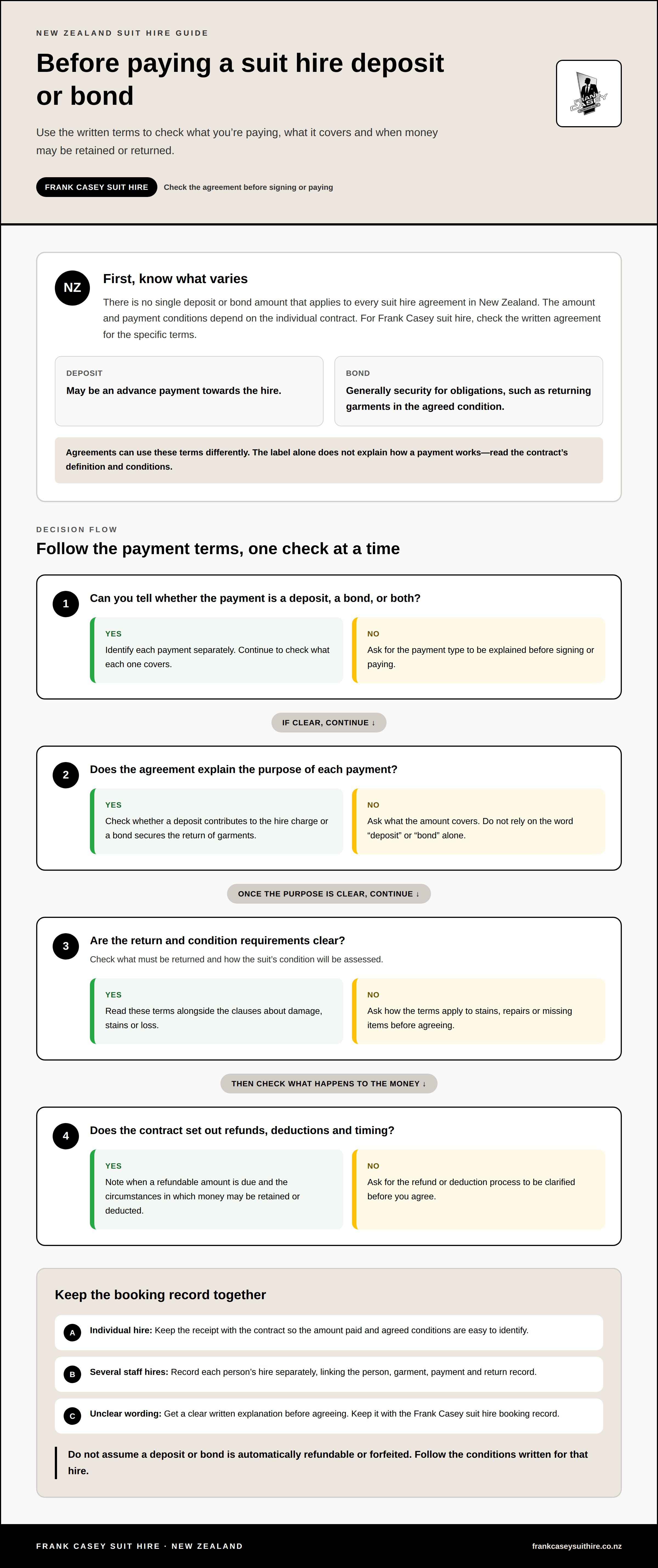
There isn’t one deposit or bond amount that applies to every suit hire agreement in New Zealand. The amount and payment conditions depend on the individual contract. Before paying, distinguish the deposit from any bond, then check what each payment covers and when it may be returned or retained. Understanding suit hire contracts NZ hirers sign starts with knowing what each payment means. For Frank Casey suit hire, check the written agreement for these details too.
A deposit may be recorded as an advance payment towards the hire. A bond is generally security for obligations such as returning garments in the agreed condition. Agreements can use these terms differently, so the label alone doesn’t explain how a payment works. Look for the contract’s definition and the conditions attached to it.
For example, an agreement could describe a deposit as part of the hire charge and a separate bond as security for returning the suit. This isn’t a standard New Zealand practice; it shows why the written terms matter. The contract should make clear which payment is which, what it covers and what happens after the hire ends. A guide to understanding suit hire contracts NZ customers enter should make this distinction clear.
Read the payment section alongside the return and damage clauses. A bond’s handling may depend on whether the suit and included items are returned, and whether the agreement records damage or loss. A deposit may be treated differently from a bond if a booking is cancelled. Don’t assume either payment is automatically refundable or forfeited. Follow the conditions written for that hire.
Before agreeing, identify these details in the contract:
- Payment type: Is the amount a deposit, a bond, or both?
- Purpose: Does it contribute to the hire charge or secure return of the garments?
- Return conditions: What must be returned, and how is the condition assessed?
- Refund or deduction process: What circumstances allow money to be retained or deducted?
- Timing: When does the agreement say any refundable amount will be returned?
If a term is unclear, ask what it means before signing or paying. For instance, if the agreement says a bond can cover “damage”, find out how that applies to stains, repairs or missing items. When arranging Frank Casey suit hire, ask for clarification on any unclear payment terms before you agree. A clear written explanation can help prevent a later disagreement. Keep the agreement and payment record together so you can identify the amount paid and the agreed conditions.
If you’re arranging several suits for employees, record each person’s hire separately. A simple register can connect the person, garment, payment and return record without mixing one worker’s bond with another’s. For an individual hire, keep the receipt with the contract. These steps make it easier to see what was paid and which agreement governs the hire.
The Glenfield Community Centre hire agreement requires the hirer to meet the Health & Safety in Employment Act 2015 requirements. It also requires a parent or designated caregiver aged at least 18 to accompany children under 18 at all times.
What are the pickup and return deadlines for suit hire in New Zealand?
The hire agreement sets the pickup and return deadlines for each booking. There isn’t one date or time that applies to every suit hire. The schedule may depend on the event date, collection arrangement and return process. Read the dates and times as carefully as the hire period. A note saying “return after the event” can cause confusion if it doesn’t specify the deadline.
Start with the collection details. For Frank Casey suit hire, check the booking record for the collection date, location and any stated collection window. If you need a suit for a Saturday wedding, for example, collecting it on Friday may leave time for a fitting and final check. That’s a planning scenario, not a standard collection rule. The written booking terms determine the actual collection date.
Give the return terms the same attention. Check the deadline, where to return the suit and any instructions for included items. If the agreement names a Monday return, note whether it also specifies a time or return method. A date without a time can create uncertainty, particularly if travel or work commitments affect the return.
If you’re arranging hires for staff, keep each person’s schedule separate. A simple record can link the worker’s name with their collection date, event date and return deadline. For example, if several employees attend one function, a shared calendar can show who is responsible for returning each hire. This helps prevent one person’s return arrangements from being confused with another’s.
Before the event, make a clear timeline using the dates in the agreement:
- Collection: Record the agreed date, location and time window.
- Fit check: Allow time between collection and the event to try on the complete outfit.
- Event: Keep the event date visible beside the hire period.
- Return: Record the deadline, return location and any instructions for accessories.
- Handover: Keep a note or receipt showing the suit has been returned.
If plans change, communicate the new timing before relying on it. A message requesting a later return doesn’t automatically change the written deadline unless the change is accepted. Keep any agreed amendment with the booking record. This is especially useful when different people organise collection, wear the suit and return it.
For an employee, the return deadline applies to the hired garments, while workplace duties are separate. An employer can clarify responsibilities by sharing the relevant schedule with the employee and recording who handles each step. A written timeline helps both parties follow the same collection and return plan, especially when a work event involves several suits.
Who is liable for damage, stains, or loss under a suit hire contract in NZ?
The person or organisation named as the hirer is the starting point for checking responsibility under the contract. The wording matters: it may specify who must return the suit and what happens if garments are damaged, stained or lost. Understanding suit hire contracts in NZ includes reviewing these liability terms before accepting a booking. Frank Casey suit hire customers should check who entered the agreement and what each party agreed to do. If an employer arranges a hire for an employee, neither should assume the other automatically carries every responsibility.
For example, an employer may book a suit for an employee attending a work function. If the employer signs as the hirer, the contract may place return obligations on the employer, even though the employee wears the suit. A separate workplace arrangement can explain the employee’s responsibilities, but it doesn’t automatically replace the hire contract. Keeping both records helps distinguish obligations to the hire business from expectations between employer and employee, including when arranging Frank Casey suit hire.
Damage can mean different things in different agreements. A small mark, a torn seam and a missing jacket are distinct examples. Read the terms for cleaning, repair, replacement and deductions. If a clause uses broad wording such as “damage”, look for how the condition is assessed and what costs may be recovered. Understanding suit hire contracts in NZ means reading that wording alongside the circumstances, rather than assuming ordinary wear and accidental damage are treated identically.
If a stain or tear appears, record the facts promptly. Note which garment is affected, when you noticed it and what happened. A wine spill at a reception, for instance, differs from a mark discovered before the event. Keep photographs and relevant messages with the hire record. Avoid trying to remove a stain with a household product, as unsuitable treatment could affect the fabric or complicate assessment. This applies to garments hired through Frank Casey suit hire, too.
Loss also requires attention to the agreement. A jacket left at a venue, a missing tie and an unreturned suit are different situations. The contract may explain how to report missing items and what happens if they can’t be recovered. If you’re managing several hires, use a garment checklist, assign each item to its wearer and record its return. This makes it easier to identify a genuinely missing piece.
When a dispute arises, compare the contract with the return record, photographs and messages. Ask for an itemised explanation of any proposed deduction, including the clause relied on and the garment concerned. Keep communication factual. A clear record of the suit’s condition before collection and after return can help establish what happened, without assuming liability before considering the agreement and evidence. Keep these records for any Frank Casey suit hire booking.
What are the cancellation, refund, and alteration rules for suit hire in New Zealand
A cancellation request, refund and alteration are separate parts of a suit hire agreement. The written terms explain how each is handled. For example, cancelling a booking before collection differs from asking for a trouser adjustment after collection. Read the clause for the specific change instead of assuming one rule covers every situation. When considering Frank Casey suit hire, check its written terms for these details.
For a cancellation, identify how notice must be given and when it takes effect. The contract may describe how to notify the hire business and explain how any payment is treated. If an event date changes, send a clear written cancellation or amendment request. Keep the reply with the booking record so the agreed outcome is easy to distinguish from an unanswered message. For Frank Casey suit hire bookings, keep this confirmation with the original agreement.
Refund terms should explain what happens to payments already made. Check whether the agreement treats a deposit, bond and hire charge differently. These payments may have separate purposes and conditions. For instance, a booking cancelled before collection could be treated differently from a suit returned after use. The payment label alone doesn’t determine whether money is refundable; the relevant contract clause does, including for Frank Casey suit hire.
Alterations need their own process. Shortening trousers, adjusting a sleeve or changing a size may affect the garment and collection timing. Find out whether the agreement allows the requested change, who arranges it and whether the fit must be reviewed before the event. Don’t arrange work independently if the contract requires approval first. Record the approved change in writing, including for Frank Casey suit hire.
If you’re booking suits for staff, attach each cancellation or alteration to the correct worker’s booking. If one employee can no longer attend a function, make sure their cancellation isn’t confused with someone else’s fitting. A simple record can include the employee, garment, change requested, date sent and written response. This also helps separate booking records from workplace decisions.
Use this short review before accepting a cancellation, refund or alteration outcome:
- Find the clause: Locate the specific wording for cancellation, refunds or garment changes.
- Match the situation: Note whether the suit has been collected, altered or worn.
- Send the request clearly: State the booking details and the change being requested.
- Keep the response: Save written confirmation and any revised terms with the original agreement.
A wedding date moved after a suit booking is a clear example. The hirer can submit the new date as an amendment request, then keep the written response with the original terms. If the request is to cancel instead, the cancellation clause applies. This ties the decision to the actual agreement rather than assumptions about standard refund or alteration rules, including when using Frank Casey suit hire.
What happens if a suit is returned late in New Zealand
The hire agreement sets the return deadline and explains what happens if the suit is returned late. There isn’t one late-return charge or rule for every New Zealand hire. Read the clause for any additional hire period, charge, bond deduction or other consequence. A late return can also affect the next booking if another customer needs the same garment.
Start by identifying the exact deadline. Check the return date, time and location rather than relying on a general phrase such as “the next day”. For example, a Monday return deadline may include a stated closing time. Returning the suit after that time could be treated differently from returning it within the agreed window. The contract determines the applicable process.
If travel, illness or an event overrun could delay the return, contact the hire business as soon as you know there may be a problem. Give the booking name, garment details and expected return time. Follow up a phone conversation with a written message to create a record of what was discussed. Don’t assume that notifying someone automatically changes the deadline; keep any agreed change with the booking.
A late return may make the garments unavailable for another hire. Imagine a suit scheduled for collection by another customer on Tuesday. A delay on Monday could affect that booking, so the agreement may explain how an extended hire or resulting costs are handled. Any charge or deduction should be tied to the contract terms. Don’t assume a bond is automatically kept or that an extra day is free.
If you’re coordinating hires for several employees, assign one person to track each return. A shared record can show the worker, garment, deadline, return location and handover status. If an employee is travelling after a function, note who will return the suit instead. This helps prevent a missed handover from being mistaken for a completed return.
If the return is already late, act promptly:
- Contact the hire business: Give the booking details and a realistic return time.
- Follow the agreed method: Use the return location or instructions in the contract.
- Keep evidence: Save messages and any proof of handover or delivery.
- Review any charge: Compare its reason with the late-return clause and request an explanation if needed.
For a future event, build the return deadline into the travel plan and staff roster. Explore Frank Casey suit hire options when arranging formalwear for an occasion.
If a late-return issue also raises a concern between an employer and an employee, keep that concern distinct from the hire agreement and its return terms. The deadline for raising an employment relationship problem should not be assumed to decide whether a hire charge is payable. In New Zealand, most employment relationship problems must be raised within 90 days. Keep the relevant agreement, messages and handover evidence together, and seek advice about the appropriate process if both issues arise. For the hire question, continue to ask Frank Casey suit hire to explain any charge by reference to the agreed late-return terms.
Frank Casey
Frank Casey can help when you’re arranging formalwear hire for an event. Once you’ve reviewed the agreement’s payment, collection, return and care terms, choose the suit hire option that fits the occasion. Frank Casey offers hire for weddings, black tie events, business occasions and school balls.
If you’re organising formalwear for staff, clear booking details can help connect each hire to the right wearer and event. If you’re choosing a suit for yourself, having the occasion and requirements in mind makes it easier to discuss suitable options. The agreement still sets the conditions for each hire, so review its terms before confirming your booking.
Contact Frank Casey to discuss suit hire for your occasion.
Make your next formalwear booking with confidence
Use your understanding of suit hire contracts in NZ to start clearer conversations before your next workplace event. Agree who will coordinate the booking, who will wear each suit and how the hire details will be recorded. Keeping those roles clear can make formalwear arrangements easier for employers and employees to manage.
Frank Casey offers Black Tie Suits, Wedding Suits and Business Suits for different occasions. If you’re arranging formalwear for a team or choosing a suit for an upcoming event, consider which option suits the setting and wearer. A considered choice helps you move from contract details to a polished look with less uncertainty.
Contact Frank Casey to discuss your suit hire needs and take the next step towards your event with confidence.
Frequently Asked Questions
What is a suit hire contract in New Zealand?
A suit hire contract is an agreement between the hirer and the hire business for temporary use of formalwear. It sets out the terms for a particular booking, not the terms of someone’s job. For example, if an employer books formalwear for a staff function, the suit agreement covers that hire. It doesn’t replace the employer’s separate responsibilities under the employment relationship.
What terms should a New Zealand suit hire agreement include?
A useful agreement identifies the hirer, the garments included and the booking period, then explains the arrangements for that hire. For a group booking, the record should make clear which employee is associated with each outfit and booking. It should also explain how changes are recorded. This gives the employer and wearer a shared reference for a Frank Casey suit hire booking.


