

What if the biggest measurement mistake isn’t the number, but where you place the tape? If you’re learning how to measure yourself for a suit online, it’s understandable to worry that one misplaced inch could affect the fit. Use clear body landmarks, keep the tape in the right position and check your figures before submitting them.
This guide explains which measurements to take, where the tape should sit and how to record each result consistently at home. You’ll also learn why body measurements may not match the measurements on a retailer’s size chart, and how to enter your details in the format requested.
We’ll go through the measuring process, then cover checks to catch common errors before you order. Some retailers may also offer digital measurement tools, so follow the instructions for whichever option you use. If a measurement request or fit point isn’t clear, ask for advice rather than guessing. For suit hire, check how professional fitting applies to your order.
Key Takeaways
- For how to measure yourself for a suit online, prepare a flexible tape measure, close-fitting clothing and a clear record for each figure.
- Take the main measurements in a consistent order and write each one down straight away to avoid mixing up figures.
- Match your body measurements to the retailer’s size-chart fields, and ask the retailer for guidance if you fall between sizes.
- Repeat any measurement that looks inconsistent, checking that the tape is level and your posture is relaxed.
- Before ordering, review your measurements, units, size chart and event date. Use your figures to start a suit hire or retail enquiry, not as a guarantee of fit.
How to Measure Yourself for a Suit Online: Start with the Right Preparation
Before picking up the tape, check the retailer’s measurement guide and size chart. Instructions can differ, so use the retailer’s specified landmarks, units and measurement format rather than relying on a generic method. If you’re unsure how to measure yourself for a suit online, careful preparation is more useful than trying to copy the measurements of a suit you already own.
A body measurement is a figure taken around or along the wearer; a garment measurement describes the dimensions of the clothing itself. This distinction matters when you compare your figures with a size chart. A favourite suit can help you explain how you like clothes to fit, but its measurements won’t be the same as your body measurements.
What to prepare before taking suit measurements
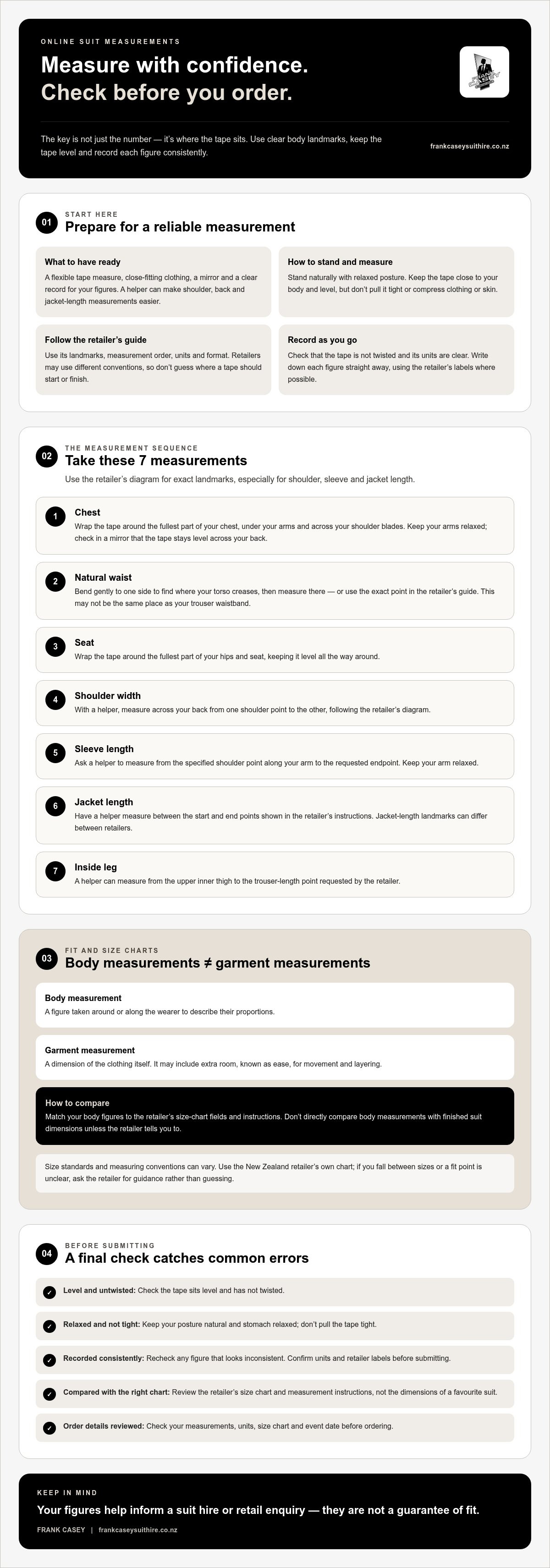
Gather a flexible tape measure, close-fitting clothing, a mirror and something to record your figures in. A helper can make measurements across your shoulders, back or jacket length easier to take consistently. Stand naturally in light clothing that doesn’t add bulk, with your posture relaxed. Keep the tape level and close to your body, but don’t pull it tight or compress your clothing or skin.
Check that the tape hasn’t twisted and that you can read its units clearly. If the retailer requests centimetres, record centimetres throughout rather than converting or trying to remember figures later. Write each result down as you go, using the retailer’s labels where possible.
Body measurements versus suit measurements
Your body figures describe your proportions. Garment figures describe a jacket or pair of trousers, which may include extra room, known as ease, to allow for movement and layering. Retailers may also use different conventions for where or how a measurement is taken. A body measurement and a finished garment measurement aren’t automatically a direct match.
Size standards have developed differently across markets and over time. For background, see the history of U.S. standard clothing sizes, but use the New Zealand retailer’s own chart and instructions to choose a size. Don’t compare your body figures directly with the dimensions of a finished suit unless the retailer specifically tells you to. If the chart or measuring method isn’t clear, ask the retailer for guidance before submitting your details.
How to Take the Main Measurements for an Online Suit Order
Follow the retailer’s measurement order and diagram if it provides one. Macy’s step-by-step measurement guide illustrates several common suit measurements, but conventions can vary between retailers. Stand naturally, keep the tape level where it goes around your body and record each figure straight away in the requested units.
Before ordering, check your chest, natural waist, seat, shoulder width, sleeve length, jacket length and inside leg against the retailer’s instructions.
Measure the upper body for a suit jacket
For your chest, wrap the tape around the fullest part, passing under your arms and across your shoulder blades. Keep your arms relaxed and the tape level without pulling it tight. To find your natural waist, bend gently to one side and note where your torso creases. This may not be the same position as your trouser waistband.
Ask a helper to take your shoulder width, sleeve length and jacket length, and follow the retailer’s diagram for the exact start and end points. Shoulder width is generally measured across the back between the shoulder points. Sleeve and jacket length can use different landmarks, so use the endpoints shown in the retailer’s instructions rather than choosing your own.
Measure the waist, seat and inside leg
Take these measurements at the positions specified by the retailer. Keep your stomach relaxed, stand comfortably and avoid pulling the tape tight. For inside leg, a helper can make it easier to measure from the upper inner thigh to the trouser length point requested by the retailer.
- Chest: Loop the tape around the fullest part of your chest. Check in a mirror that it stays level across your back.
- Natural waist: Measure around your torso at the natural waist, or at the precise point shown in the retailer’s guide.
- Seat: Wrap the tape around the fullest part of your hips and seat, keeping it level all the way around.
- Shoulder width: With a helper, measure across your back from one shoulder point to the other, following the retailer’s diagram.
- Sleeve length: Ask your helper to measure from the specified shoulder point along your arm to the requested endpoint. Keep your arm relaxed.
- Jacket length: Have your helper measure from the retailer’s stated starting point, often near the back of the neck, down to the requested jacket hem point.
- Inside leg: Measure from the upper inner thigh to the trouser length point specified by the retailer. Don’t assume every chart uses the same endpoint.
Write each result beside its label before moving on. If you’re preparing to enquire about suit hire or retail options, these figures can help you explain your fit questions, but they don’t guarantee a particular fit.
How to Check Your Suit Measurements Against an Online Size Chart
Once you’ve recorded your figures, compare each one with the matching field on the retailer’s size chart. Check the chart’s measuring instructions too. A familiar label may refer to a different landmark or to the garment rather than your body. Retailer-specific sizing guidance should take precedence over any generic size conversion.
Match each figure to the retailer’s size chart
Use the chart as a guide to that retailer’s sizing, not as a universal conversion. Before comparing numbers, check that the measurement name, tape position and units match.
| Your body measurement | Corresponding size-chart field to check |
|---|---|
| Chest | Chest or jacket chest |
| Natural waist | Waist |
| Seat | Seat, hip or trouser hip |
| Shoulder width | Shoulder or across-back measurement, if listed |
| Sleeve length | Sleeve |
| Jacket length | Jacket or coat length |
| Inside leg | Inside leg or trouser length |
Not every retailer lists all these fields, and labels can vary. Some charts give body measurements; others show garment dimensions. If a chart only provides a general size, follow its stated method for choosing that size rather than treating every measurement as an exact match.
What to do when measurements sit between sizes
Don’t automatically size up or down. First, recheck the measurement that falls between chart values, using the retailer’s stated tape position and units. Then compare your other figures with the relevant chart fields. A close match in one area doesn’t necessarily settle the choice if another measurement differs.
Fit can vary between brands and suit cuts, even when the label shows the same size. Ready-to-wear sizing uses the retailer’s existing size options, while made-to-measure generally adjusts a base pattern to a wearer’s measurements. Neither approach makes sizing interchangeable between retailers. The cut and the retailer’s instructions still matter.
If the chart doesn’t explain how to handle a mismatch, contact the retailer before ordering and share the measurements that don’t align. This is a useful final step in learning how to measure yourself for a suit online: use your figures to ask a clear question instead of guessing at a size.
Avoid These Common Mistakes When Measuring for a Suit Online
Small changes in posture or tape position can alter a reading. When learning how to measure yourself for a suit online, aim for repeatable measurements rather than trying to make a number fit a size chart.
Signs that a measurement may be inaccurate
Pause and check your technique if the tape is twisted, slants around your body, digs in or leaves a gap. Bulky clothing can add extra room to a reading, while raised shoulders or holding your breath can change how your upper body sits. Guessing or rounding a figure without being asked can also make it harder to compare your measurements with the retailer’s chart.
Use this quick routine to repeat a measurement:
- Stand naturally in the same light clothing, with your shoulders relaxed and breathing normally.
- Check that the tape is in the correct position and level where it goes around your body.
- Take the measurement again and record both readings with their units.
If the readings differ enough that you’re unsure which is accurate, don’t average them or choose one at random. Reset the tape position, check your posture and start again. Record the figure as instructed, and avoid rounding unless the retailer requests it.
When to ask for help instead of guessing
Measuring alone can be convenient, and a mirror can help you check tape placement. But it’s harder to keep the tape straight and reach landmarks across your back. A helper can check whether the tape is level and assist with difficult measurements, but they’ll still need to follow the retailer’s diagram. Photos may support a fit check if the retailer requests them, but they don’t replace the measurements it asks you to provide.
If a measurement is awkward to take or a size-chart field is unclear, ask the retailer what it means rather than guessing. For suit hire, professional fitting can provide further fit guidance. Check how fitting applies to your online enquiry before relying on it.
For fit questions, ask about suit hire and professional fitting before ordering.
What to Do After Measuring Yourself for a Suit Online
Your measurements are useful preparation, not a guarantee of fit. Before you order or enquire, check your figures against the retailer’s current size chart and review its instructions for submitting measurements. Keep a note of how you took them so you can explain any uncertainty clearly.
Prepare your measurements before ordering or enquiring
Keep a tidy record with each measurement beside its name, the units used and any relevant notes about how you took it. For example, identify whether a figure is a body measurement or one taken from a garment. Confirm that your figures follow the retailer’s method, and check whether the order form asks for centimetres, a labelled size or another format.
Check your event date before proceeding, particularly if the suit is for a wedding, school ball or another occasion with a fixed date. If you’re considering suit hire, ask how professional fitting applies to your online arrangements before assuming a fitting is part of the process. Your measurements can help start a clear enquiry, but they don’t replace any fitting or advice the retailer recommends.
Choose the right next step for your occasion
Suit hire can suit a one-off event, while buying a suit may be the right choice if you want to keep it for future wear. The occasion can help guide your options: a wedding, for instance, may call for a different level of coordination than a business suit. If you’re measuring for a wedding, consult a wedding suit guide as you consider the occasion, overall look and fit questions to raise.
Frank Casey serves customers nationwide, with online ordering and nationwide delivery. Use your recorded measurements to explain what you’re looking for and where you’re unsure. Ask how professional fitting applies to your suit hire enquiry, and confirm any order-specific instructions before submitting details. A clear question is better than a guess.
Explore Frank Casey’s suit hire and retail options when you’re ready, and raise any fit questions before ordering.
Take Your Measurements into the Next Step
Good online suit sizing starts with careful, repeatable measurements and the retailer’s own instructions. Keep a clear record of your figures and units, then check each one against the relevant size-chart field. If a measurement seems unusual or sits between sizes, recheck it or ask for guidance rather than guessing.
Knowing how to measure yourself for a suit online can help you prepare for an enquiry, but measurements alone can’t guarantee fit. Frank Casey serves customers nationwide with online ordering and delivery across New Zealand. Professional fitting services and post-event cleaning are included with suit hire, so check how fitting arrangements apply to your order before proceeding.
Whether you’re considering suit hire for an event or looking to buy a suit, explore Frank Casey’s suit hire and retail options and raise any fit questions as you plan your next step. With your measurements organised, you’re ready to make an informed enquiry.
Frequently Asked Questions
How do I measure myself for a suit online without help?
You can take most suit measurements yourself with a flexible tape measure, mirror and notes. Stand naturally in light clothing, keep the tape level and comfortably close, and follow the retailer’s measurement instructions. Chest, waist and seat measurements are generally easier to take alone. For shoulder width, sleeve length or jacket length, a helper can make it easier to keep the tape in the right position. Record each figure and its units, then recheck any reading that seems inconsistent.
What measurements do I need to order a suit online?
Retailer requirements vary, so check the order instructions first. Common measurements include chest, natural waist, seat, shoulder width, sleeve length, jacket length and inside leg. Some retailers may request fewer or additional details, or use different labels for the same area. Match each body measurement to the retailer’s specified field and units. Don’t assume another retailer’s list or size chart uses the same landmarks or method.
Can I measure myself for a suit with a tape measure?
Yes. A flexible tape measure is suitable for taking body measurements at home. Stand naturally in close-fitting clothing, make sure the tape hasn’t twisted, and keep it level where it goes around your body. It should sit close without digging in or compressing you. Follow the retailer’s guide for each start and end point, and write down every figure straight away. A mirror can help you check the tape’s position.
How do I measure my chest for a suit jacket?
Wrap the tape around the fullest part of your chest, passing under your arms and across your shoulder blades. Let your arms rest naturally and breathe normally. Check in a mirror that the tape sits level around your body, then note the reading without pulling it tight. Use the retailer’s exact instructions if they show a different position or request a garment measurement instead of a body measurement.
Should I use body measurements or a suit that already fits?
Use body measurements if the retailer asks for them. They describe your body, while measurements taken from a suit describe the garment, which may include extra room for comfort and movement. A suit that fits well can help you explain your preferred feel, but don’t compare its dimensions directly with a body-measurement chart unless the retailer instructs you to. Follow the retailer’s own chart and measuring method.
What should I do if my measurements fall between suit sizes?
Recheck the measurements that sit between sizes, making sure you used the retailer’s specified tape position and units. Then compare your other figures with the relevant chart fields. Don’t automatically size up or down, as the best choice can depend on the brand, suit cut and sizing guidance. If the chart doesn’t explain how to handle the mismatch, contact the retailer and ask before placing your order.
Can I use online measurements to hire a suit?
Yes, measurements can help you start a suit hire enquiry and explain any fit concerns, but they don’t guarantee fit or necessarily replace a fitting. Frank Casey offers suit hire and serves customers nationwide, with online ordering and delivery across New Zealand. Professional fitting services are included with suit hire; check how fitting arrangements apply to your order before proceeding. Share your measurements and ask about any unclear fit or order instructions.


